Functionalities
Application Administrator- to view this screen
- to make changes in this screen
This section is used to configure functionalities or modules added to TrustFactor.
Set up functionalities access
Manage Applications- to view this screen
- to make changes in this screen
Before configuring a feature, you must grant the application access based on the active features in your environment. Examples of such features include:
- 3DS SIBS
- Virtual Agents
- Real-Time Authentication Service
- Maker Checker
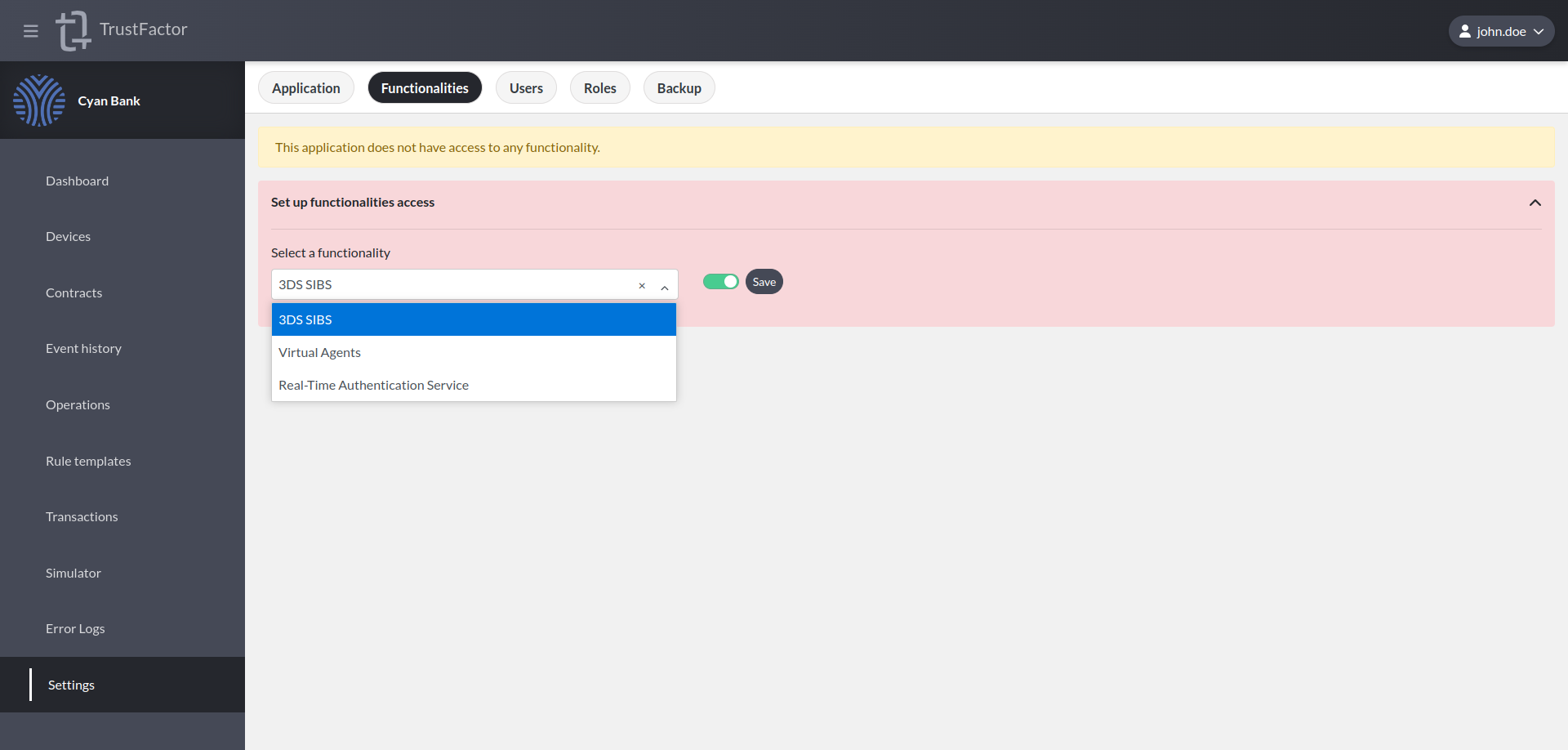
After enabling access to at least one feature, you will be able to see the screens documented below and can proceed with the configuration of the respective features.
Configurate
3DS SIBS
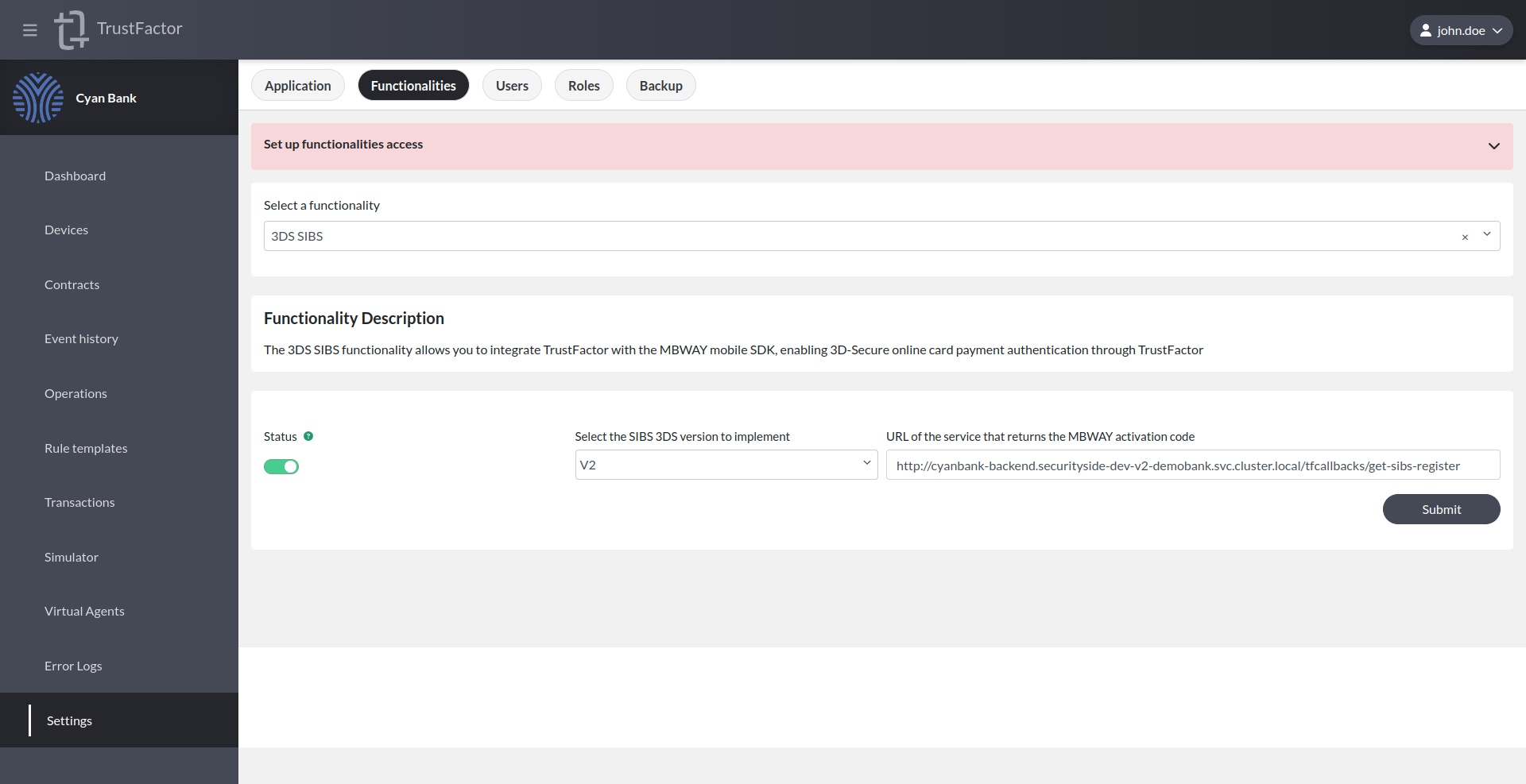
The 3DS SIBS functionality allows you to integrate TrustFactor with the MBWAY mobile SDK, enabling 3D-Secure online card payment authentication through TrustFactor. This functionality requires embedding the SIBS MBWAY SDK on the TrustFactor Agent applications and so is available for Private Cloud.
There are two different versions of the SIBS MBWay implementation: v1 and v2. v1 is not recommended for new implementations, as it lacks the ability to interact with pending authentication requests, knowing the final status of the authentication, among others, so new implementations should always target v2.
The SIBS 3DS v2 implementation requires:
- C# SDK v3.1.0 or higher
- Java SDK v3.2.0 or higher
In these SDK versions there are methods to create SIBS 3DS V2 transactions, to update the status of SIBS 3DS V2 transactions when the decision callback is received from SIBS and also to get a new SIBS MBWAY SDK activation code. This last endpoint is required and must be configured in the screen as shown above.
Maker Checker
Maker Checker requires a contract removal performed from the Backoffice to be approved by other operators before it is carried out. The operator who requests a removal can never approve it, so a single account cannot remove a contract on its own. Application administrators always remove contracts directly.

There is a single setting:
- Required approvals: how many operators, besides the one asking, must approve before a contract removal is carried out.
Setting it to 1 means every removal needs one maker and one checker: two different people. Setting it to 0 means no approval is required, and removals are carried out straight away even while Maker Checker is active.
The environment sets a ceiling on this value, and the screen tells you what it is. If the application is currently configured above that ceiling, saving lowers it to the maximum.
Activating Maker Checker does not by itself require any approval. A freshly activated application still needs an administrator to set the number of required approvals before removals start being gated.
Requests waiting for approval are listed in the Removal approvals screen, which any operator with Manage Contracts can reach. Turning Maker Checker off stops the gate immediately, but requests that were already waiting are kept.
Real-Time Authentication Service
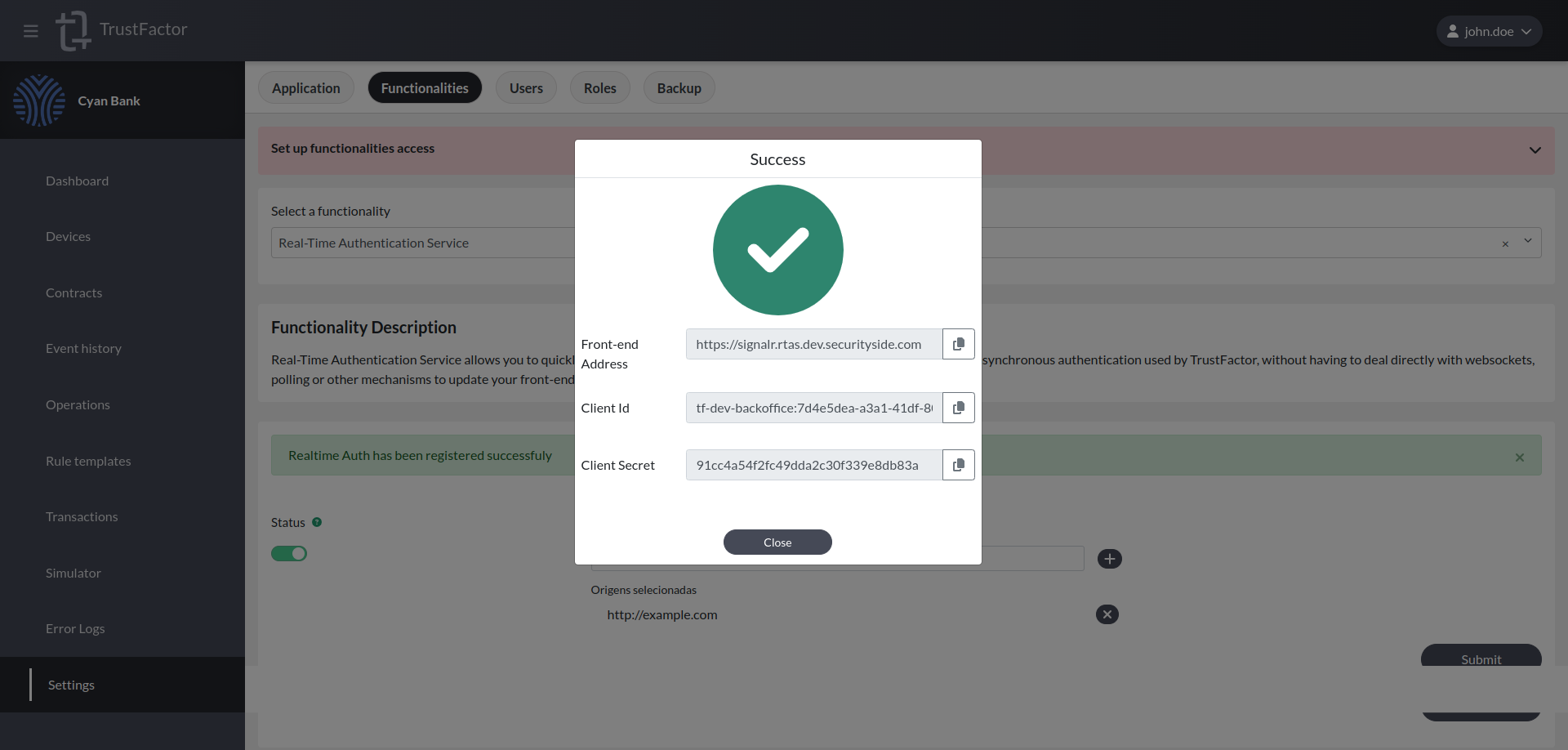
Real-Time Authentication Service (RTAS) allows you to quickly and simply implement on your front-end clients (web and mobile) the asynchronous authentication used by TrustFactor, without having to deal directly with websockets, polling or other mechanisms to update your front-ends when authentications or registrations are concluded.
This external service uses its own SDK for backend applications and also has a Javascript component to use in the front-end application (mobile or web). Please contact SecuritySide support for more information on this service and how to use it.
In order to get credentials for RTAS, you can use the functionalities tab. You need to set:
- Allowed Origins: Define the front-end application origins (http://example.com) from which the Javascript code will contact RTAS. If you intend to use mobile webviews, don't forget to add null as well.
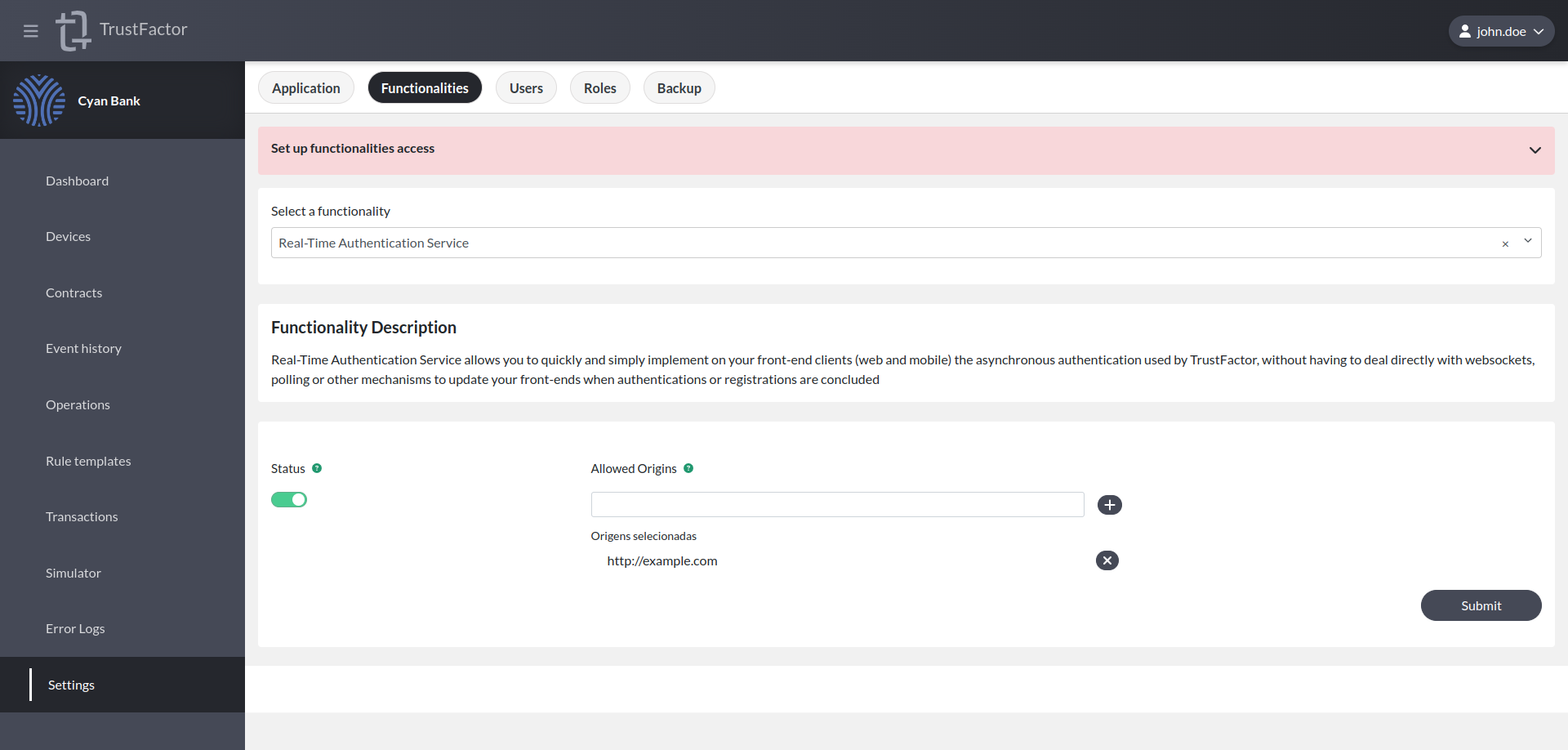
After activating the service, you will see a pop-up showing you the endpoint address, the clientId and clientSecret of your application, all of which will be needed on the RTAS backend and frontend SDKs in order to authenticate your users.
Virtual Agents
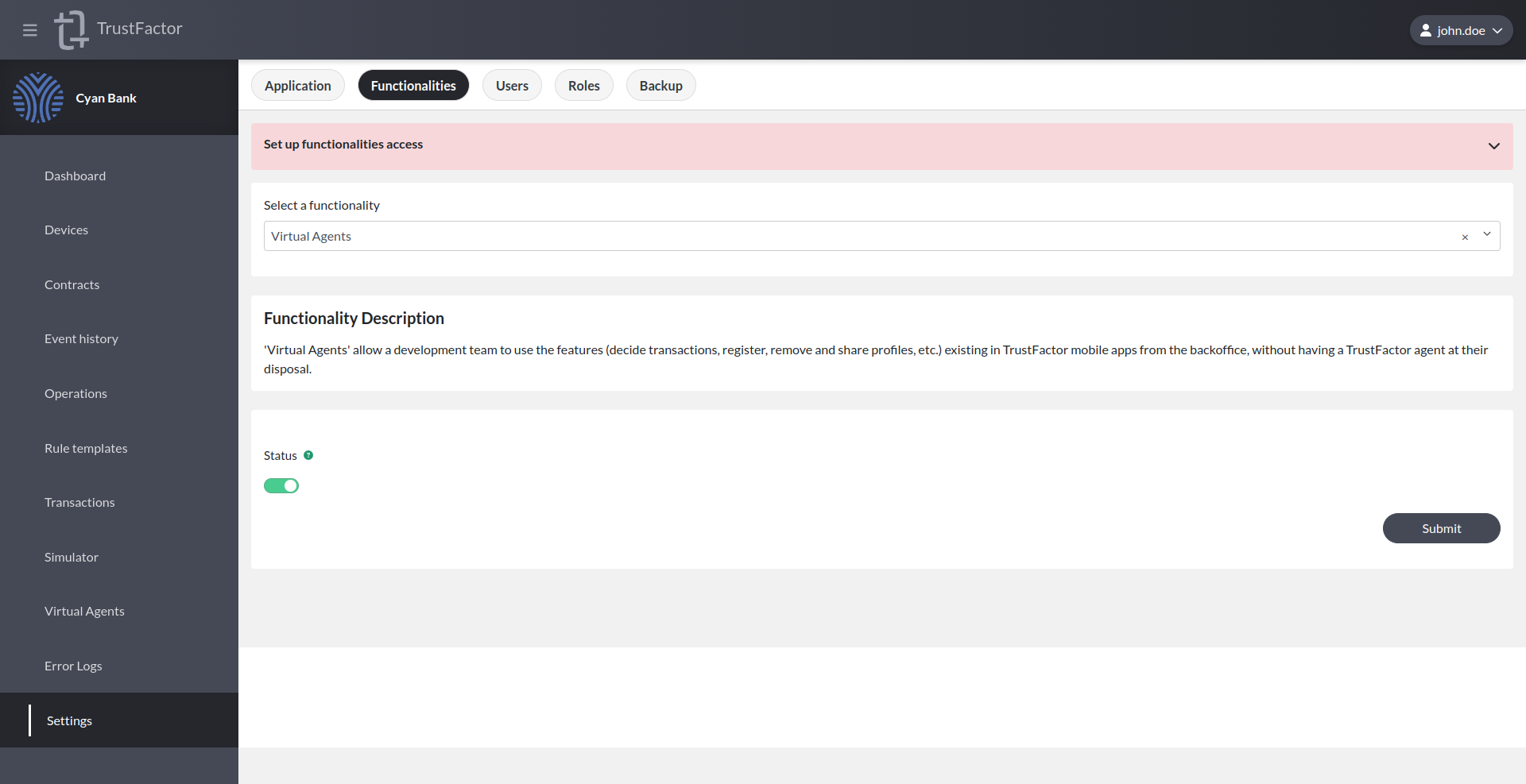
'Virtual Agents' allow a development team to use the features (decide transactions, register, remove and share profiles, etc.) existing in TrustFactor mobile apps from the backoffice, without having a TrustFactor agent at their disposal.